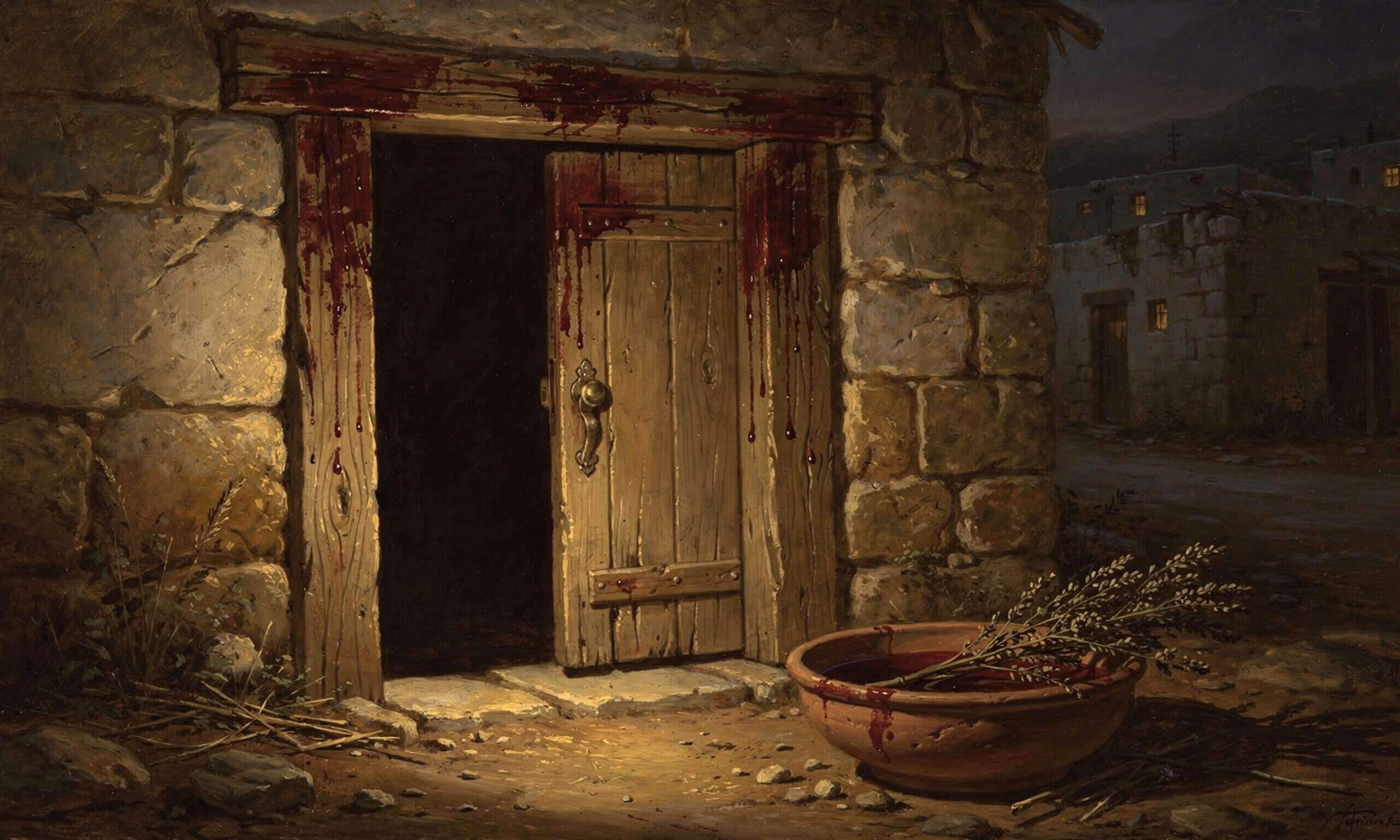
In the first month, on the fourteenth day of the month in the evening, is YHWH’s Pesach. Vayikra 23:5 · KWS
The Torah Mitzvah
Year by year. The fourteenth of the first month. At evening.
The first moed YHWH named in Vayikra 23 is Pesach. It is fixed to His calendar — the fourteenth day of the first set-apart month (Aviv / Nisan), at twilight. The lamb is selected on the tenth day, kept until the fourteenth, then slaughtered between the evenings Shemot 12:3–6. Its blood marks the doorposts. Its body is eaten roasted, with unleavened bread and bitter herbs.
The instruction is not optional and not vague: This day shall be a memorial for you. You shall keep it as a feast to YHWH. You shall keep it as a feast throughout your generations by an ordinance forever. Shemot 12:14 Forever — not until a future replacement, not until the cross. Forever.
When I see the blood, I will pass over you, and no plague will be on you to destroy you… Shemot 12:13 · KWS
The Scripture Observance
The blood, the matzah, the bitter herbs.
Pesach was lived first in Egypt, the night YHWH went through the land. Where the blood of the lamb was on the doorposts, He passed over the house and did not allow the destroyer in Shemot 12:23. The lamb itself was eaten that night — roasted whole, no bone broken Shemot 12:46 — together with matzah (unleavened bread) and bitter herbs Shemot 12:8. The household ate dressed for travel, ready to go. Deliverance was not slow; it came in one night.
Every generation since has been commanded to teach the children why: It is because of that which YHWH did for me when I came out of Egypt. Shemot 13:8 The Pesach meal preserves the memory in the body of the household. Tell the story.
Yeshua in Pesach
Not after Pesach. Not symbolic of Pesach. The Pesach.
Yeshua ate a last meal with the twelve on the night He was betrayed Mattityahu 26:17–30. It is often called the Pesach seder. It was not. Yochanan dates that meal before the feast of the Pesach… Yochanan 13:1, and the next morning the leaders would not enter the Praetorium that they might not be defiled, but might eat the Pesach Yochanan 18:28 — the seder was still ahead of them. The day He hung on the cross was the Preparation Day of the Pesach… Yochanan 19:14. He did not eat the Lamb that year. He was the Lamb. He was crucified on the fourteenth day of the first month, in the hours Israel was slaughtering its Pesach lambs in the temple. His bones were not broken Yochanan 19:33–36 — fulfilling the requirement of Shemot 12:46 to the letter. John the Immerser had named Him at the start: Behold, the Lamb of Elohim, who takes away the sin of the world! Yochanan 1:29
Three Days and Three Nights
Count the sign He gave, and the week falls into place.
Yeshua staked His whole claim on one measurement. "As Jonah was three days and three nights in the belly of the huge fish, so will the Ben Adam be three days and three nights in the heart of the earth" Mattityahu 12:40 Friday evening to Sunday morning is one night, one day, and part of a second night. It is not the sign He gave.
Start where the reckoning starts — at sundown, not at midnight. The last meal was eaten after sunset, so the meal and the cross fall on the same set-apart day: the fourteenth of the first month, the Preparation Day Yochanan 19:14. Through that night came the betrayal, the arrest and the trials; in the daylight that followed, the cross. He died in the hours the lambs were being slaughtered, and was in the tomb before the sun went down.
Then the count runs. Sundown began the fifteenth — the first day of Unleavened Bread, an annual set-apart day. That is the sabbath the burial was hurried for, and Yochanan marks it precisely: for that Shabbat was a special one… Yochanan 19:31 A high day, not the weekly seventh. Two sabbaths stood in that week, and between them lie three nights and three days.
Which lands the resurrection at the close of the weekly Shabbat — and the text says exactly that. "After the Shabbat, as it began to dawn on the first day of the week, Mary Magdalene and the other Mary came to see the tomb" Mattityahu 28:1 They did not arrive to watch Him rise. They arrived to find Him already gone. The stone was moved for the witnesses, not for the Son. First Fruits carries the rest.
The objection, and the answer. Mattityahu opens the account differently: Now on the first day of unleavened bread, the disciples came to Yeshua, saying to him, “Where do you want us to prepare for you to eat the Pesach?” Mattityahu 26:17 Read plainly in a Roman week, that sounds like the seder. Read on YHWH's calendar, it does not. The fourteenth is the day the leaven is put away and the lamb is made ready — the day of preparation, which is exactly what Yochanan calls it. The feast proper begins at sundown, on the fifteenth.
So both accounts stand, and they say the same thing. The disciples prepared the Pesach on the fourteenth. Yeshua ate with them as that day began, told them what the bread and the cup now meant, and before the same day was over He had become what they had prepared. That is not a contradiction between the two witnesses. It is one of them telling you the day, and the other telling you what filled it.
You have made the mitzvah of Elohim void because of your tradition. Mattityahu 15:6 · KWS
What the Institutional Church Did
Easter — the day they unhitched from the moed.
For the first three centuries, the assemblies of Yeshua kept Pesach on the fourteenth of the first set-apart month, alongside the Yehudim — because that is when the Lamb was slain, and that is when Mashiach, the true Pesach, died.
At the Council of Nicaea in 325 CE, Constantine and the bishops untethered the resurrection celebration from YHWH's calendar. They ruled it would fall on the Sunday after the first full moon following the spring equinox — a scheme of their own, cut loose from the month of Aviv and its fourteenth day — explicitly to break with "that hostile rabble of the Yehudim." In English the day came to be named for a Germanic dawn goddess, Ēastre: Easter.
Different day, different name, different calendar. The day Yeshua actually died was severed from the day the institutional church chose to remember Him, and the connection between the Lamb of Pesach and the Lamb on the cross was hidden from a billion people for seventeen centuries.