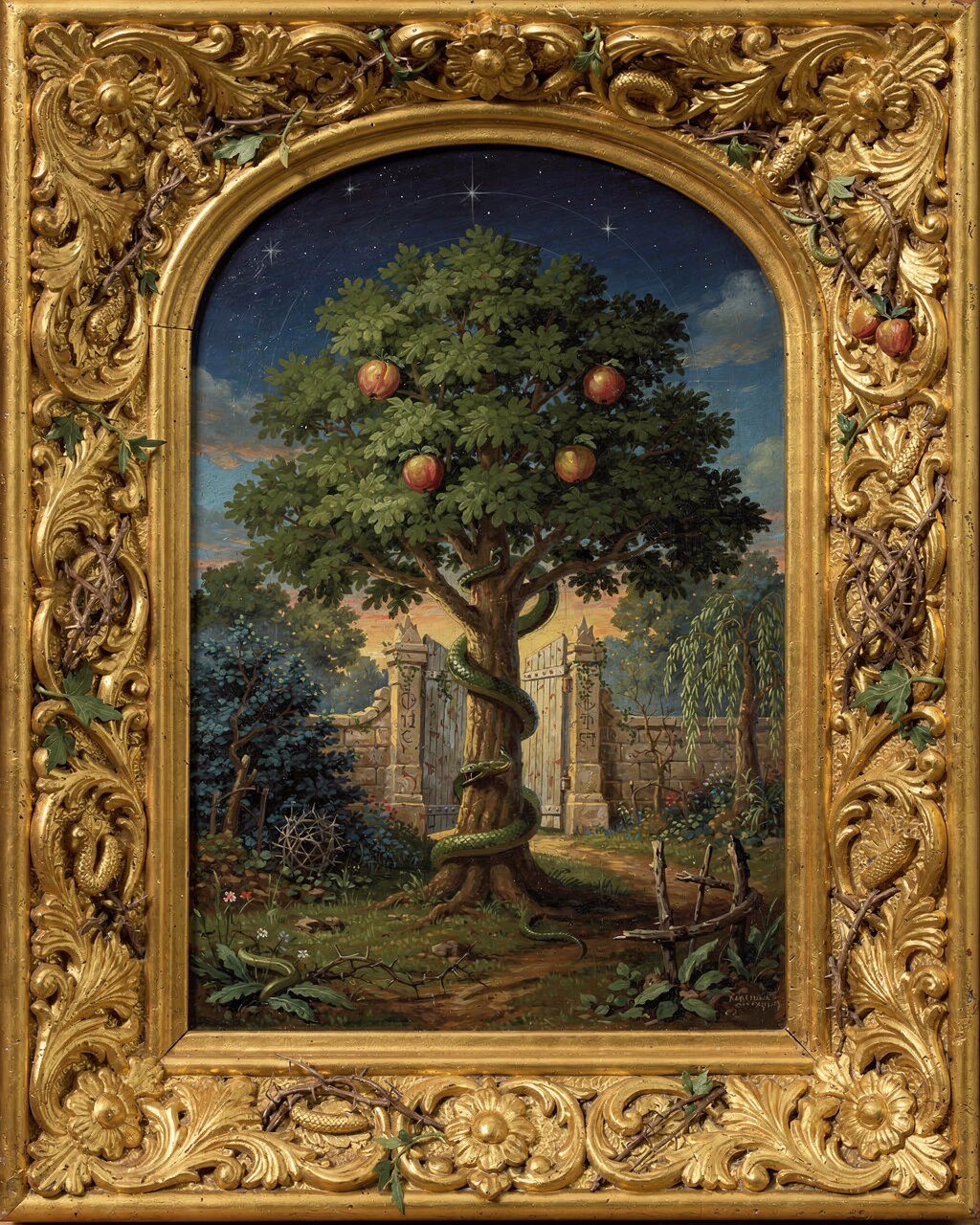
The Fall
Paradise broken — and the first promise of a Rescuer
He will bruise your head, and you will bruise his heel.
Bereshit 3:15
It did not stay good for long.
Into the garden came a question, hissed by the serpent: Did Elohim really say? It was not a frontal attack but a whisper aimed at trust — a suggestion that the Father was holding something back, that His word could not quite be believed, that the man and woman might do better deciding good and evil for themselves. The woman saw that the tree was good for food and pleasing to the eye and able to make one wise, and she took, and ate, and gave to her husband, and he ate. It was such a small thing to reach for. It broke everything.
At once they knew they were naked, and they were ashamed, and they hid. When they heard Elohim walking in the garden they ran from the very One they had walked with. This is what sin does — not only break a rule, but wreck a relationship; turn open faces into hidden ones, turn a Father's footstep into a thing to fear. Asked what he had done, the man blamed the woman; the woman blamed the serpent. Already the fracture was spreading sideways between them.
And death came in, exactly as Elohim had warned. They were sent out of the garden, away from the tree of life, into a world that would now resist them — thorns in the ground, pain in childbirth, sweat and struggle and, at the end of it, dust returning to dust. The communion they were made for was cut. Heaven and earth, once seamless, were torn.
But listen to what the Father said before He said anything about thorns. Speaking to the serpent, with the man and woman listening, He made the first promise of the whole Story: He would put enmity between the serpent and the woman, and between the serpent's offspring and hers; her seed would crush the serpent's head, even as the serpent struck His heel. In the very hour of the catastrophe, before the punishment was even spoken, the Father promised a Rescuer — a child of the woman who would one day undo what had just been done, taking a wound in the doing of it. Every page after this is the keeping of that promise. The Seed is Yeshua, and the Father had Him in view before the first tear was dry.
And then the Father did something tender. He made garments of skin and clothed them with His own hands. To cover their shame, something had to die. The first death in the Story is not a man but a substitute, a life given so the guilty could be covered — the faintest sketch of a Lamb who would one day cover not their shame only but yours.
What follows shows how far the break would reach. A son murders his brother in the very next generation. Violence fills the earth until Elohim grieves that He made it, and only Noach and his household are carried through the flood in the ark. Afterward, humanity gathers to build a tower at Bavel to make a name for itself, reaching for heaven on its own terms, and is scattered across the face of the earth in a confusion of tongues. The story of sin is not one bad apple but a flood — pride, violence, and self-rule spreading into every family and every nation.
So the world you actually live in is explained on these early pages: beautiful still, but bent; full of glory, but groaning; haunted by a memory of the garden and a longing it cannot satisfy. Death is real. Shame is real. The distance is real. But so is the promise. From the moment the world broke, the Father was not wringing His hands — He was already on His way, with a Seed in mind and His own Son in view, walking the long road that ends at a cross and an empty tomb. The Rescuer was promised before the door of the garden ever closed.